INFORMATION SYSTEMS. COMPUTER SCIENCES. ISSUES OF INFORMATION SECURITY
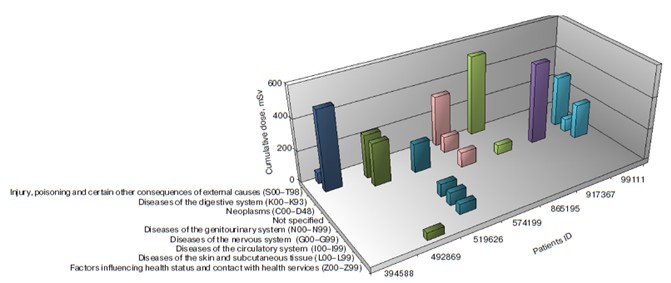
A developed algorithm for the creation and functioning of an information and analytical system for the retrospective accounting, analysis and visualization of cumulative doses of ionizing radiation received by patients undergoing radiation diagnosis and treatment was presented.
Objectives. The widespread use of computed tomography (CT) for diagnostic and treatment purposes can lead to excessive cumulative doses of ionizing radiation received by patients in medical institutions. Currently, there are no effective methods of visualization and control of cumulative doses of patients in medical institutions. Thus, there is a need for operational monitoring of the dose load from ionizing radiation. The purpose of this work is to present a developed algorithm for the creation and functioning of an information and analytical system (IAS) for the retrospective accounting, analysis and visualization of cumulative doses of ionizing radiation received by patients undergoing radiation diagnosis and treatment.
Methods. When forming visual output forms for accounting, analyzing and identifying critical values of the dose load of ionizing radiation and the number of CT scans of patients, structured query language (SQL) was used to select the necessary data in order to apply them in summary tables and volumetric diagrams.
Results. An algorithm has been developed for the formation and functioning of IAS based on client-server technology using summary tables and volumetric diagrams in a client application. The algorithm can be used to visualize the analysis and accounting of cumulative doses of ionizing radiation in patients undergoing treatment and medical examination in large multifunctional medical research hospitals, identify the types of CT scans for reducing the number of sessions and limit the growth of cumulative doses of ionizing radiation in patients, as well as to detect errors in data entry by medical professionals into medical information systems and provide timely correction. In addition, an unlimited number of forms can be created for viewing, analyzing, and accounting for data.
Conclusions. The developed methodology for the formation of IAS can be scaled up to other multidisciplinary medical centers for tracking critical values of cumulative doses of ionizing radiation in patients in order to apply the necessary medical solutions in radiation diagnosis.

- A probabilistic model for the overload risk of Kubernetes compute nodes was developed.
- This model formalizes overload as the first instance of a critical boundary being reached by a stochastic load process.
- The model was validated using a discrete-event simulator for a 170-node cluster under four workload scenarios.
- A systematic comparison with four baseline methods (Persistence, Linear trend, AR(1), and Historical exceedance) across 904800 test windows demonstrates the superiority of the FP model in terms of the Brier score (0.0245 vs 0.0372 for the best baseline) for all prediction horizons (1, 2, 5, and 10 min).
Objectives. In containerized computing infrastructures, workload placement relies on static parameters such as requests and limits . However, the stochastic nature of actual resource consumption, involving rare but significant peak bursts, can lead either to excessive resource reservation or an increased risk of overload. Existing approaches to resource allocation focus on deterministic node selection criteria or point forecasts of workloads, but do not provide direct probabilistic estimates of critical state thresholds. The probabilistic model for the overload risk of Kubernetes compute nodes developed in this paper formalizes overload as the first instance of a critical boundary being reached by a stochastic load process.
Methods. The normalized node load is modeled as a one-dimensional stochastic process, the probability density of which evolves according to the Fokker–Planck equation. An analytical solution to the boundary-value problem is derived for constant coefficients and mixed Robin–Dirichlet boundary conditions. For variable coefficients estimated from telemetry data, a numerical method based on the Crank–Nicolson scheme is employed. The drift and diffusion coefficients are estimated from monitoring data.
Results. The model was validated using a discrete-event simulator for a 170-node cluster under four workload scenarios. A verification of the developed numerical solution against an analytical solution on six test cases produced a discrepancy of less than 0.001. A systematic comparison with four baseline methods (Persistence, Linear trend, AR(1), and Historical exceedance) across 904800 test windows demonstrates the superiority of the FP model in terms of the Brier score (0.0245 vs 0.0372 for the best baseline) for all prediction horizons (1, 2, 5, and 10 min).
Conclusions. The proposed model provides a calibrated, probabilistic estimate of Kubernetes node overload risk over a finite prediction horizon, which outperforms baseline methods in terms of both calibration and discrimination metrics. These results pave the way for the development of risk-aware node ranking mechanisms and the integration of probabilistic risk assessment into container cluster management systems.
MULTIPLE ROBOTS (ROBOTIC CENTERS) AND SYSTEMS. REMOTE SENSING AND NON-DESTRUCTIVE TESTING

- The presented ontological model and methods for conditional and unconditional diagnostics is used to establish cause-and-effect relationships between observed failures and the malfunctions that cause them.
- Based on an ontological approach and taking into account the availability of advanced tool support, including ontology description languages, ontology modeling tools, and ontology-based inference and reasoning technologies, a new paradigm is identified for the development of a promising class of autonomous robotic systems with increased fault tolerance and, consequently, adaptability.
Objectives. The work set out to develop diagnostic tools and methods for autonomous robots for the rapid detection of faults based on the analysis of cause-and-effect relationships between observed manifestations and the sources of failures.
Methods. The paper presents an analytical review of the current scientific and technical literature on the topic of the research, which includes ontology construction methods for developing a diagnostic model for autonomous robots, Boolean algebra methods for generating queries to the ontological diagnostic model, modifications to conditional and unconditional diagnostic methods for finding cause-and-effect relationships between failures and malfunctions based on the use of an ontological model, and machine experimentation methods for estimating the processing time of queries to the ontological diagnostic model.
Results. The presented ontological model and methods for conditional and unconditional diagnostics is used to establish cause-and-effect relationships between observed failures and the malfunctions that cause them.
Conclusions. Based on an ontological approach and taking into account the availability of advanced tool support, including ontology description languages, ontology modeling tools, and ontology-based inference and reasoning technologies, a new paradigm is identified for the development of a promising class of autonomous robotic systems with increased fault tolerance and, consequently, adaptability. The development of an autonomous robot presupposes the presence of an onboard intelligent control system built on a hierarchical principle that comprises executive, tactical, and strategic levels. The results of the ontological model provide an effective basis for activating and utilizing the intelligent control system’s rich algorithm databases at all levels of the control hierarchy to support increased adaptability.

- The developed and tested prototype roller conveyor system for a drone port outperforms potential alternative systems, such as belt conveyors, gear-driven roller conveyors, and chain-driven roller conveyor systems, across a range of performance criteria.
- Experimental tests of the toothed-belt-driven roller conveyor prototype under loads of up to 100 kg confirmed stable operation at speeds of 5–15 cm/s, including on inclines of up to 6°. Power consumption did not exceed 20–25 W at a working speed of 10 cm/s and a roller working area measuring 1900 × 900 mm.
Objectives. The study aims to enhance the operational independence and uptime of unmanned aerial vehicles by developing a ground-based robotic service platform equipped with a unique conveyor system. The key technological requirement for the system is to create a lightweight, foldable conveyor that has a high throughput capacity to ensure the synchronization of all processes involved, including alignment after landing, movement, and maintenance operations.
Methods. Computer simulations and physical modeling approaches were used to evaluate the effectiveness of the proposed conveyor hardware and software solutions. In order to meet the specified operational requirements of the conveyor, a suitable system engineering methodology was employed. During the design phase, a comparative analysis of various kinematic drive systems based on chains, gears, and belts was carried out.
Results. The developed and tested prototype roller conveyor system for a drone port outperforms potential alternative systems, such as belt conveyors, gear-driven roller conveyors, and chain-driven roller conveyor systems, across a range of performance criteria. The main roller pulleys and belt support rollers are manufactured using 3D printing of engineering thermoplastics. The roller support bars are produced using 3-axis computer numerical control milling technology. The design was based on standard aluminum profiles and polymer pipes. Experimental tests of the toothed-belt-driven roller conveyor prototype under loads of up to 100 kg confirmed stable operation at speeds of 5–15 cm/s, including on inclines of up to 6°. Power consumption did not exceed 20–25 W at a working speed of 10 cm/s and a roller working area measuring 1900 × 900 mm.
Conclusions. A new design and manufacturing technology for a folding conveyor was developed and tested experimentally to meet the requirements of a robotic interflight service platform. Testing successfully confirmed the reliability of the conveyor, which is now ready to be integrated into the platform as a critical transport module. This will ensure high platform throughput while minimizing energy consumption.
MODERN RADIO ENGINEERING AND TELECOMMUNICATION SYSTEMS
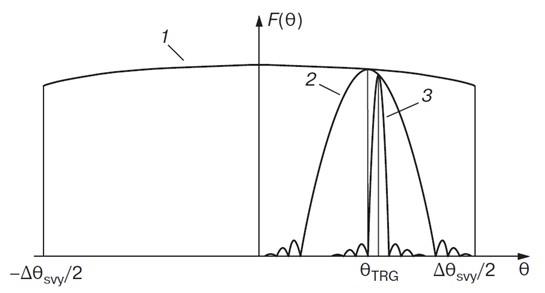
- Two space-time processing variants were synthesized to generate optimal pre-threshold statistics for a MIMO (Multiple-Input, Multiple-Output) radar detector with an M-element transmitting and N-element receiving antenna array.
- The structural diagrams of these variants were found to differ in their sequences of spatial and temporal processing.
- Due to the increased size of the equivalent aperture of the receiving antenna array, the angular resolution of the MIMO radar is demonstrated to be significantly better than that of a traditional radar at the same signal-to-noise ratio.
Objectives. In contemporary radar studies, increasing attention is being paid to MIMO (Multiple-Input, MultipleOutput) radars, which are predicted to offer significant advantages over traditional phased-array radars. MIMO radars increase spatial degrees of freedom by simultaneously transmitting coherent, orthogonal radio waveforms in parallel. The main challenge for MIMO radars is to optimize space-time processing (STP) of the entire set of echo signals against a white Gaussian noise background according to the Neyman–Pearson criterion. In order to ensure optimal detection performance, the work statistically synthesizes STP in MIMO radars to derive variants of STP structural schemes for identifying their features as compared to STP in traditional phased-array radars, and analyze the angular resolution of the MIMO radar with the resulting STP structure.
Methods. Statistical optimization methods for signal detection against interference using the Neyman–Pearson criterion were used in accordance with approaches informed by the theory of beamforming in multibeam antenna arrays.
Results. Two STP variants were synthesized to generate optimal pre-threshold statistics for a MIMO radar detector with an M -element transmitting and N -element receiving antenna array. The structural diagrams of these variants were found to differ in their sequences of spatial and temporal processing. Due to the increased size of the equivalent aperture of the receiving antenna array, the angular resolution of the MIMO radar is demonstrated to be significantly better than that of a traditional radar at the same signal-to-noise ratio.
Conclusions. The structural diagrams of the synthesized MIMO radar detectors confirm their statistically optimal detection performance.

- An effective method for suppressing additive Gaussian noise in radio channels to ensure the high-quality reconstruction of digitally modulated signals at low signal-to-noise ratio.
- The proposed model achieves an average improvement of 2–3 dB in output SNR (signal-to-noise ratio, SNR) compared with the Relativistic Average Generative Adversarial Network under identical simulation conditions, as well as a more than a 10 dB improvement as compared with the wavelet-transform-based method.
- The best performance is achieved with 128 hidden units and a deep ResBiLSTM-BiGRU (Long Short-Term Memory (LSTM) and Gated Recurrent Unit (GRU)) architecture.
Objectives. The work sets out to develop an effective method for suppressing additive Gaussian noise in radio channels to ensure the high-quality reconstruction of digitally modulated signals at low signal-to-noise ratio (SNR) levels.
Methods. To address this problem, a hybrid architecture is proposed that combines Long Short-Term Memory (LSTM) and Gated Recurrent Unit (GRU) recurrent neural networks. The ResBiLSTM-BiGRU model enables more stable training and improved reconstruction quality, as well as more accurate modeling of the temporal structure of signals. The performance of the model was evaluated using a multi-modulation dataset with various input SNR levels.
Results. As confirmed by the experimental results, the proposed model achieves an average improvement of 2–3 dB in output SNR compared with the Relativistic Average Generative Adversarial Network (RaGAN) under identical simulation conditions, as well as a more than a 10-dB improvement as compared with the wavelet-transform-based method. The model is characterized by lower mean squared error values and higher correlation coefficients across the entire input SNR range from –10 to 10 dB. The peak SNR values also indicate high signal reconstruction quality, especially at low input SNR levels. Analysis of architectural parameters shows that the best performance is achieved with 128 hidden units and a deep ResBiLSTM-BiGRU architecture.
Conclusions. The obtained results confirm the effectiveness and practical applicability of the proposed ResBiLSTM-BiGRU hybrid architecture for suppressing additive Gaussian noise in radio channels and reconstructing digitally modulated signals, particularly under low-SNR conditions.
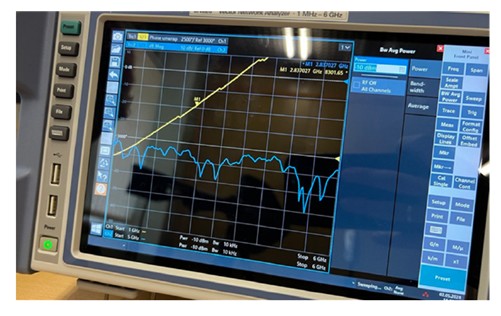
- A new method for vector tracking-formation of signal radio images of Small-Size Objects (SSO) from traditional pulsed methods of near-field radio vision lies in the use of an S-parametric model of a spatial N-pole to describe the inhomogeneous medium, as opposed to approaches based on scalar signal transformation.
- To analyze the accuracy of the method, a model of operator ψ-transformation has been proposed, allowing for the evaluation of projective distortions in vector radio images of SSO signatures.
Objectives. The aim of this article is to investigate the possibility of forming vector radio images of small-size objects (SSO) using a digital vector network analyzer (VNA) with a controllable bandwidth and frequency step of the tracking generator.
Methods. The work is based on the comprehensive application of the following methods: analysis of radio wave processes in the context of radio vision, the apparatus of N -pole theory, numerical methods of statistical radio engineering, and computer modeling (including both electromagnetic and functional-block simulation).
Results. A new method for vector tracking-formation of signal radio images of SSO has been developed. Its fundamental difference from traditional pulsed methods of near-field radio vision lies in the use of an S -parametric model of a spatial N -pole to describe the inhomogeneous medium, as opposed to approaches based on scalar signal transformation. To analyze the accuracy of the method, a model of operator ψ-transformation has been proposed, allowing for the evaluation of projective distortions in vector radio images of SSO signatures. Verification of the method was carried out on a custom-developed software-hardware complex based on the R&S ZNLE6 VNA. The complex provides coherent processing and verification of signal radio images of SSOs recorded under the influence of non-fluctuating interference.
Conclusions. During the research, a method for vector tracking-based formation of radio images with spectrotemporal unfolding of the power spectral density function was proposed. This method is free from the limitations of pulsed analogs and can be used as one of the solutions for verifying SSO in near-range radio vision. The foundation of the proposed method can be a model of an inhomogeneous medium as a spatially-oriented system of coupled N -poles, described by S -parameters. The practical effectiveness has been experimentally confirmed: the probability of verifying a SSO reaches at least 0.94 (Neumann–Pearson criterion) with a signal-to-noise ratio ≥15 dB and a signal-to-interference ratio ≥9 dB. These results are of practical value for the development of near-field radio vision technologies.
MICRO- AND NANOELECTRONICS. CONDENSED MATTER PHYSICS
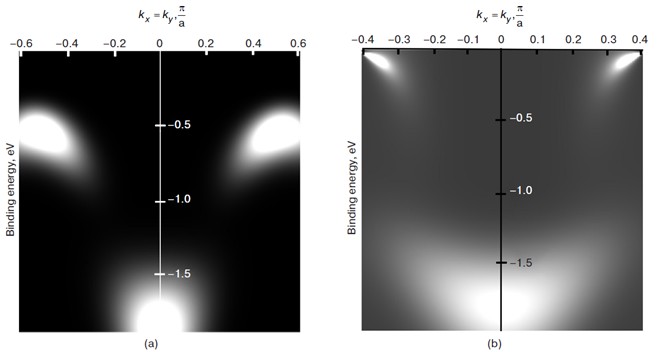
- Angle-resolved photoemission spectra of systems with strong electron–phonon interaction and cuprate-like dispersion were calculated using the parameters of a two-fluid charge-carrier system, which were obtained by minimizing the free energy of the system.
- Features of the resulting spectra observed in the experimental spectra of cuprate superconductors with the corresponding doping level provide a basis to analyze their physical causes.
Objectives. The nature of the “waterfalls” observed in the photoemission spectra of cuprate high-temperature superconductors is explained by calculating the angle-resolved photoemission spectra of systems with significant electron–phonon interaction and dispersion law characteristic of cuprates. The resulting spectrum is compared with the results of experiments on superconducting cuprates.
Methods. Photoemission spectra obtained within a two-component model, comprising a liquid of large-radius bipolarons and a Fermi liquid of delocalized charge carriers, are calculated based on Fermi’s golden rule using the bipolaron and polaron binding energies, polarization field energy, and wave functions of charge carriers in them. The approach is based on previous findings that such a two-liquid system forms the ground and weakly excited states of systems with strong Fröhlich electron–phonon interaction.
Results. Angle-resolved photoemission spectra of systems with strong electron–phonon interaction and cupratelike dispersion were calculated using the parameters of a two-fluid charge-carrier system, which were obtained by minimizing the free energy of the system. Features of the resulting spectra observed in the experimental spectra of cuprate superconductors with the corresponding doping level provide a basis to analyze their physical causes.
Conclusions. The model used for the calculations is characterized by different energies of relaxation following the photoemission from the self-trapped state and delocalized state, which coexist and divide the momentum space in accordance with the Pauli exclusion principle under long-range strong electron–phonon interaction. This energy difference, which leads to the formation of so-called waterfalls in the angle-resolved photoemission spectra (ARPES spectra) in the nodal direction, also determines their heights. The wave vector of the waterfall is associated with the equilibrium size of bipolarons at given doping level and temperature by the uncertainty principle, as well as the change in this wave vector with varying doping level that agrees with the phenomena observed in the experimental spectra.
MATHEMATICAL MODELING

- A numerical algorithm for simulating a two-dimensional flow of a micropolar fluid in a plane channel with a moving upper wall (Couette flow) was developed in order to investigate the influence of micropolarity parameters on the flow structure.
- Steady-state velocity and microrotation fields were obtained for a Couette flow at Reynolds number Re = 100 with micropolarity parameters N = 3 and m = 0.015.
- The numerical method demonstrated stable convergence within 5000 iterations to achieve residuals of 3 ∙ 10−6 for velocity components and 1.5 ∙ 10−6 for microrotation.
- Visualized results include the vector velocity field and streamlines, as well as distributions of microrotation, vorticity, and energy dissipation.
- A nonuniform microrotation field was formed having maximum values (~0.45 rad/s) localized in the corner regions of the channel.
Objectives. The study develops an efficient numerical algorithm for simulating a two-dimensional flow of a micropolar fluid in a plane channel with a moving upper wall (Couette flow) in order to investigate the influence of micropolarity parameters on the flow structure.
Methods. The equations governing the dynamics of a micropolar fluid are solved using the projection method with explicit time integration. Spatial discretization is performed by the finite difference method on a uniform 51 × 51 grid. The convective terms are approximated using a first-order upwind scheme to ensure stability at moderate Reynolds numbers. The microrotation and momentum conservation equations are solved separately, followed by a pressure correction to satisfy the incompressibility condition.
Results. Steady-state velocity and microrotation fields were obtained for a Couette flow at Reynolds number Re = 100 with micropolarity parameters N = 0.3 and m = 0.015. The numerical method demonstrated stable convergence within 5000 iterations to achieve residuals of 3 ∙ 10[−6] for velocity components and 1.5 ∙ 10[−6] for microrotation. Visualized results include the vector velocity field and streamlines, as well as distributions of microrotation, vorticity, and energy dissipation. A nonuniform microrotation field was formed having maximum values (~0.45 rad/s) localized in the corner regions of the channel.
Conclusions. The developed algorithm effectively simulates a micropolar fluid flow in a channel. The numerical method exhibits stable convergence to yield physically meaningful results. Micropolarity is confirmed to significantly alter the flow structure in comparison with the Newtonian case, leading to the development of a transverse velocity component and a nonlinear microrotation distribution. The obtained distributions of field characteristics can serve as a basis for further research into the rheological properties of micropolar media and for the verification of experimental data.

- This paper sets out to modernize selected steps of the statistical algorithm (Algorithm 1995) for processing data on air quality obtained from Integrated Background Monitoring Network.
- Based on a review of statistical framework of the Algorithm 1995 steps requiring modernization, a structure for the updated data processing algorithm version, Algorithm 2025, was developed.
- This new algorithm will enable the joint analysis of RosHydroMet data to mitigate the impact of noise and fluctuations in the time series of background concentrations of air pollutants.
- The effectiveness of the proposed methods for modernizing selected steps of Algorithm 1995 was substantiated.
Objectives. Since the 1980s, the Integrated Background Monitoring Network (IBMoN) operated by RosHydroMet[2] in the Russian Federation has been collecting experimental data on background levels of pollutants in environmental media, including atmospheric air, precipitation, surface water, soil, and vegetation. As part of its operations, IBMoN regularly updates recommendations and regulatory documents regarding chemical analysis methods and requirements for monitoring site placement every 5–10 years. However, the statistical framework of the network has not been revised since 1995 (Algorithm 1995). This paper sets out to modernize selected steps of the statistical algorithm for processing data on air quality obtained from IBMoN.
Methods. In the study, correlation analysis, trend analysis, descriptive mathematical statistics, and structural algorithmization methods were used.
Results. Based on a review of Algorithm 1995 steps requiring modernization, a structure for the updated data processing algorithm version, Algorithm 2025, was developed. This new algorithm will enable the joint analysis of RosHydroMet data to mitigate the impact of noise and fluctuations in the time series of background concentrations of air pollutants. The effectiveness of the proposed methods for modernizing selected steps of Algorithm 1995 was substantiated.
Conclusions. Since it is not possible to obtain data in the format required by RosHydroMet without modifying some steps of the Algorithm 1995, this algorithm requires modernization. As a result of modernizing the selected steps, noise can be reduced by up to 70% to eliminate the main types of random and systematic errors caused by the human factor. However, future work is required to identify suitable approaches for modernizing the remaining steps that are not covered in this study.
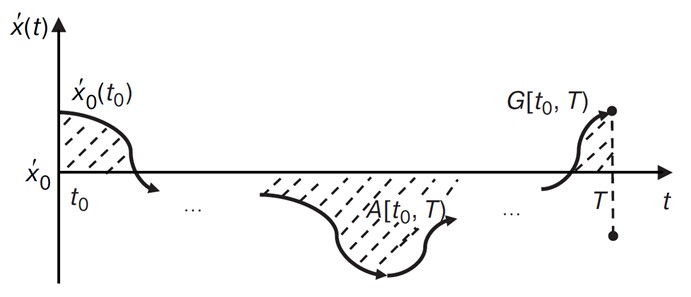
- Based on the methodology, results of the formation of new stochastic dependencies of the integral curve for solving the differential equation of dynamics of an arbitrary object are presented.
- A new random process of the dynamics of an arbitrary object was developed and investigated. Its parameters and characteristics are formed based on monitoring results in the info-communication space.
- This creates the prerequisites for automated analysis and synthesis of innovative research approaches to study dynamic processes and systems, including Big Data.
- A novel application area for the methodology of solving conditional optimization problems, previously utilized in the analysis of packet network teletraffic, was identified.
Objectives. Advances in information communication technologies, coupled with the unlimited computational capabilities of modern automation systems, make it possible to reformulate and solve differential equations in the form of the Cauchy problem using a random process theory. The present work aims to develop a random process of a stepwise model of the dynamics of an object, whose characteristics and parameters are observed and processed through monitoring. This creates the prerequisites for the formation of new information communication approaches for automated analysis and synthesis of dynamic processes and systems, including Big Data.
Methods. The research took a geometric approach to estimating the probabilities of independent events along with the mean value theorem for integrals and a method for synthesizing stochastic models of dynamic processes for various subject areas based on graphical dependencies of the first derivative.
Results. Based on the methodology, results of the formation of new stochastic dependencies of the integral curve for solving the differential equation of dynamics of an arbitrary object are presented. A new random process of the dynamics of an arbitrary object was developed and investigated. Its parameters and characteristics are formed based on monitoring results in the info-communication space. This creates the prerequisites for automated analysis and synthesis of innovative research approaches to study dynamic processes and systems, including Big Data. A novel application area for the methodology of solving conditional optimization problems, previously utilized in the analysis of packet network teletraffic, was identified.

ISSN 2500-316X (Online)