INFORMATION SYSTEMS. COMPUTER SCIENCES. ISSUES OF INFORMATION SECURITY
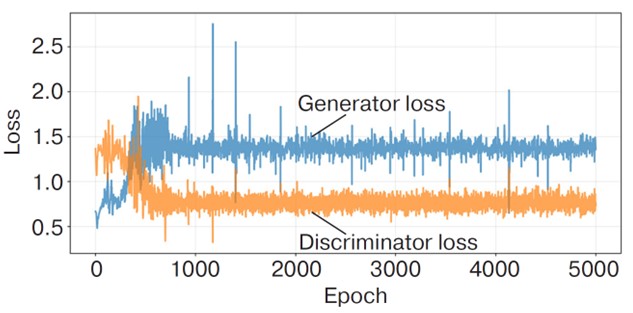
- It was demonstrated that conventional generative adversarial networks (GANs) have the capability to produce verifiable synthetic network traffic that does not deteriorate overall classifier performance, which validates proof-of-concept of GAN-based data augmentation in intrusion detection system.
- It was shown that the conventional GAN is not concerned with minority attack generation, where it produces samples based on the general distribution but without controlling the class.
Objectives. Class imbalance in intrusion detection system (IDS) datasets poses challenges for achieving balanced detection performance. Setting out to evaluate the quality and utility of GAN-generated samples for improving the generalization ability of IDS, this research presents a standard generative adversarial network (GAN) framework as a means of generating synthetic network traffic data for augmenting IDS training datasets. The main focus of the study is an assessment of whether standard GANs can produce realistic synthetic traffic that is not based on targeted generation of minority attack classes.
Methods. When implemented on the NSL-KDD, CIC-IDS2017, and CIC-IDS2018 collections, the GAN displayed precision by mimicking real network traffic distribution. This can be confirmed by inspecting the histograms of different features between flow durations and byte counts and packet rates.
Results. As well as providing stable learning, the presented framework retains diverse sample generation and generates real synthetic data examples. A Random Forest trained on real data achieved 99.86% on the CIC-IDS2017 dataset. This high level of performance was maintained using the GAN-generated synthetic data to confirm the quality of synthetic traffic generation as a tool of overall data augmentation. In contrast, a conventional GAN produces samples based on the total data distribution without focusing on particular attack type, i.e., minority attacks (user-toroot (U2R) and remote-to-local (R2L)) are not explicitly solved.
Conclusions. The paper has shown that conventional GANs have the capability to produce verifiable synthetic network traffic that does not deteriorate overall classifier performance, which validates proof-of-concept of GAN-based data augmentation in IDS. Nonetheless, the conventional GAN is not concerned with minority attack generation, where it produces samples based on the general distribution but without controlling the class. The crucial limitations of the presented methodology are that it is computationally complex and cannot target underrepresented types of attacks (U2R, R2L). Further improvements in conditional GANs should be performed in the future to make them capable of creating class-specific generation and removing class disparity directly in IDS datasets.
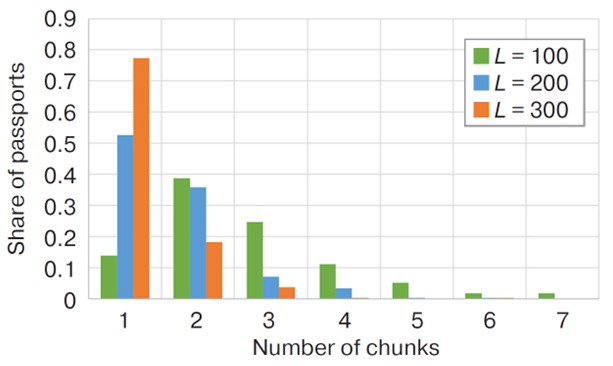
- A semantic-ontological model for scientific text analysis that can support practical tools for establishing information morphism was developed.
- By using VAK specialty passports as the textual ontological basis, it was proposed a graph-based model that reconstructs a proximity profile to specialty codes from an article or dissertation abstract to map the document space to the passport space.
Objectives. The work considers whether a semantic-ontological model for scientific text analysis can support practical tools for establishing information morphism. Using VAK6 specialty passports as the textual ontological basis, we propose a graph-based model that reconstructs a proximity profile to specialty codes from an article or dissertation abstract to map the document space to the passport space.
Methods. Processing the passports as a single corpus, a shared unigram and bigram vocabulary is constructed from their chunks. Term frequency is computed in the form of inverse document frequency (TF-IDF) representations to construct local semantic graphs on the basis of incremental construction of an associative network (ICAN). For each document passport pair, similarity measures are merged into a hybrid metric by aggregation within lexical and semantic layers. Scores are converted into a probability distribution via codes based on temperature softmax functions. The model is evaluated on a corpus of dissertation abstracts and a corpus of articles of VAK list journals7, and the results are compared with large language models.
Results. The hybrid scheme, which achieves average top 1 accuracy of about 0.69 and top 3 of about 0.90 on abstracts, reaches 0.91 and 0.93 on articles to outperform lexical-only and semantic-only variants. Considered relative to large language models, the hybrid scheme achieves superior top 1 accuracy for articles and comparable accuracy in top 3, while remaining interpretable through n grams and contextual passport graphs.
Conclusions. The proposed model, which uses VAK passports to provide a practical ontological foundation, represents an interpretable and computationally efficient alternative for code selection and thematic profiling that accounts for interdisciplinarity.
MULTIPLE ROBOTS (ROBOTIC CENTERS) AND SYSTEMS. REMOTE SENSING AND NON-DESTRUCTIVE TESTING
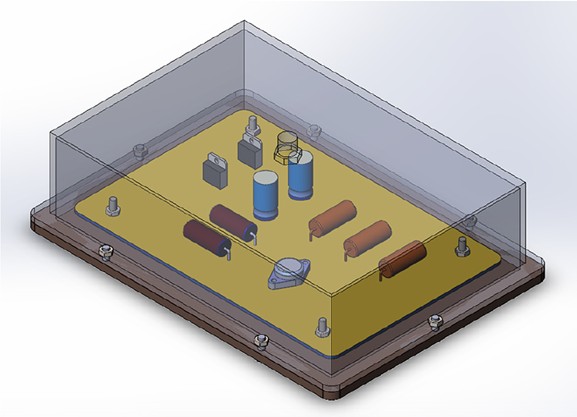
- A vibration diagnostics method to improve the reliability of detecting and classifying latent defects in printed circuit board assemblies in sealed blocks was developed.
- It based on their mechanical amplitude-frequency characteristics using a deep neural network.
Objectives. Structural defects may arise during the production and operation of printed circuit board assemblies (PCBAs) installed in radio-electronic assemblies (REAs) due to manufacturing imperfections or the influence of external factors. Of particular concern are latent defects that cannot be detected after the PCBA has been manufactured and which may lead to failures during operation. The typical installation in sealed enclosures of modern PCBAs, which are characterized by a high density of electronic components, significantly complicates the use of conventional inspection and diagnostic methods. This study aims to improve the reliability of detecting and classifying latent defects in PCBAs in sealed blocks based on their mechanical amplitude-frequency characteristics (AFCs) using a deep neural network.
Methods. The paper proposes a vibration diagnostics method based on the numerical modeling of mechanical processes, experimental vibration testing, and the application of an artificial neural network for technical condition classification. Diagnostics involves analyzing the obtained mechanical AFCs using an accelerometer mounted on the enclosure and comparing them with a database of calculated AFCs generated for various technical states of the PCBA.
Results. To verify the proposed method experimentally, a PCBA mock-up was fabricated and installed inside an enclosure with various structural defects introduced into its design. A database of calculated mechanical AFCs was formed for both healthy and faulty states. After obtaining experimental AFCs, they were compared with the calculated data, and the introduced defects were identified using a deep neural network.
Conclusions. The developed vibration diagnostics method enables the highly accurate detection and classification of latent defects arising in radio-electronic equipment during production and operation. This improves the reliability of technical condition assessment of PCBAs.
MODERN RADIO ENGINEERING AND TELECOMMUNICATION SYSTEMS
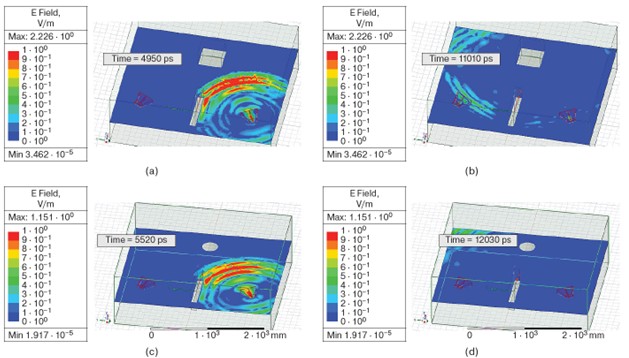
- A combined neurovision object recognition method was developed that demonstrated a probability of correct classification of at least 0.97 for any of the objects transmitted for training with specified form factors when using augmented data.
- Data augmentation was shown to increase the neural network’s probability of correct classification by 0.04.
- The proposed method was tested for basic classification of spherical and cubic object models in the centimeter radio frequency range.
Objectives. The study set out to solve the problem of radiovision classification of objects based on identified features by developing a combined neurovision algorithm for real-time recognition of signal radio images of objects using machine learning (ML) technologies and a fully connected neural network with data augmentation, as well as to improve the probability of correct classification in neurovision signal processing.
Methods. In the study, several methods were used: electrodynamic modeling, machine learning (linear regression, classification, and Random Forest), and deep learning (fully connected neural networks). The bootstrap aggregating (bagging) technique was also employed. An assessment of object classification accuracy metrics and statistical criteria for the reproducibility of radio images was carried out.
Results. A combined neurovision object recognition method was developed that demonstrated a probability of correct classification of at least 0.97 for any of the objects transmitted for training with specified form factors when using augmented data. Data augmentation was shown to increase the neural network’s probability of correct classification by 0.04. The obtained results confirm the adequacy of neural network approaches compared to classical ML methods for neurovision object recognition, particularly when dealing with a limited base dataset of objects for neural network training. The proposed method was tested for basic classification of spherical and cubic object models in the centimeter radio frequency range.
Conclusions. Neural networks with data augmentation demonstrate a probability of correct classification exceeding 0.97 for neurovision recognition of radio images as compared to neural networks without data augmentation (0.04 lower) and traditional ML methods (0.13 lower). Although ML methods are inferior to neural networks in radio image reproducibility, they remain indispensable in cases where computational resources are limited. For real-world applications, database expansion through field experiments and the implementation of hybrid neural network architectures are required.
MICRO- AND NANOELECTRONICS. CONDENSED MATTER PHYSICS
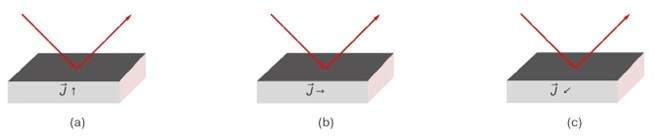
- A modeling method for multilayer structures in which magneto-optical Kerr effects can manifest themselves in individual or all layers was analyzed.
- The Berreman method, which is based on the matrix representation of Maxwell’s differential equations, is used to model all three magneto-optical Kerr effects (polar, longitudinal, transverse) in multilayer thin-film structures.
Objectives. Materials composed of numerous ultrathin layers, each having a thickness on the order of several nanometers, constitute an advanced class of composite structures exhibiting unique physical properties not typically found in conventional materials. These materials are of significant interest in both scientific and industrial sectors due to their adaptability and broad potential for application. Researchers are particularly intrigued by structures incorporating both magnetic and non-magnetic layers. The investigation of magneto-optical phenomena—particularly the Kerr effect—within these structures contributes to a deeper understanding of their physical characteristics, as well as enhancing prospects for their practical implementation. Since, to ensure the accurate interpretation of experimental data, it is imperative to consider potential interference effects, it becomes necessary to develop a mathematical model of the structure for comparing experimental findings with theoretical calculations. The purpose of this study is to analyze one of the modeling methods for multilayer structures in which magneto-optical Kerr effects can manifest themselves in individual or all layers.
Methods. The Berreman method, which is based on the matrix representation of Maxwell’s differential equations, is used to model all three magneto-optical Kerr effects (polar, longitudinal, transverse) in multilayer thin-film structures.
Results. For optically isotropic materials, Berreman matrices have been derived for experimental configurations required to observe the transverse, polar, and longitudinal Kerr effects. A method is additionally proposed to account for the influence of thick layers within the investigated structure.
Conclusions. For the matrices presented in this paper, the Berreman method was used to analyze magneto-optical Kerr effects in an isotropic medium. As well as allowing us to obtain accurate formulas for magneto-optical effects, this provided more accurate modeling of complex multilayer structures, as well as contributing to an in-depth understanding of their physical characteristics, which provides new opportunities for analyzing and searching a wide range of materials.
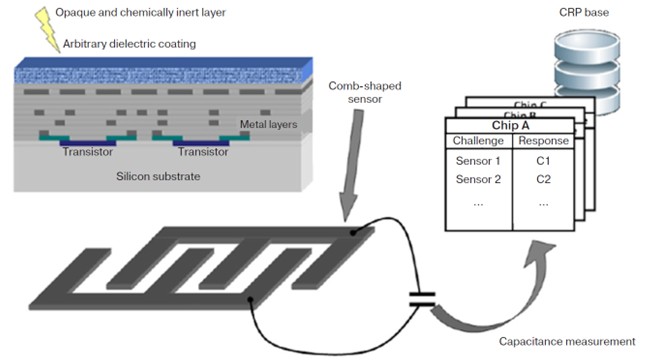
- A comprehensive overview of analog and passive physical unclonable functions was presented.
- Their vulnerabilities to machine-learning attacks were analyzed and their practical deployment in contemporary integrated circuits and Internet of Things devices was evaluated.
Objectives. The paper provides a comprehensive overview of analog and passive physical unclonable functions (PUFs), analyzing their vulnerabilities to machine-learning (ML) attacks, and assessing their practical deployment in modern integrated circuits and Internet of Things (IoT) devices.
Methods. Quantitative metrics were used to compare PUF implementations and their formal properties, such as computability, uniqueness, implementability, difficulty of cloning, and protection against unauthorized access.
Results. Analog PUFs were shown to belong to the class of “strong” PUFs. However, special measures are required to counteract environmental and ageing effects. Examples are cited to demonstrate their near-ideal uniqueness (inter-Hamming distance ≈ 50%), high stability (intra-Hamming distance < 1%), and excellent energy performance (from units to tens of femtojoules per bit). While characterized by high stability, passive PUFs are classified as “weak” PUFs. A consideration of ML-based modeling attacks confirmed that convolutional neural networks and multilayer perceptrons outperform classical approaches. By limiting the amount of data available to an attacker, protocol-level protection prevents the PUF architecture from being modified.
Conclusions. Analog and passive PUFs expand the range of tools available for hardware authentication and anticounterfeiting, particularly in low-power, resource-constrained IoT nodes. The most promising directions include architectures with on-chip self-calibration and minimal area/power overhead, as well as passive schemes for onetime identification and tamper evidence. However, open challenges remain in terms of standardizing readout and digitization procedures, increasing robustness to environmental variation and diverse attacks, and integrating error correction and post-processing on the chip. The practical adoption and selection of architectures requires conservative threat modeling and defense-in-depth strategies that account for current attack capabilities and likely future advances in ML.
ANALYTICAL INSTRUMENT ENGINEERING AND TECHNOLOGY
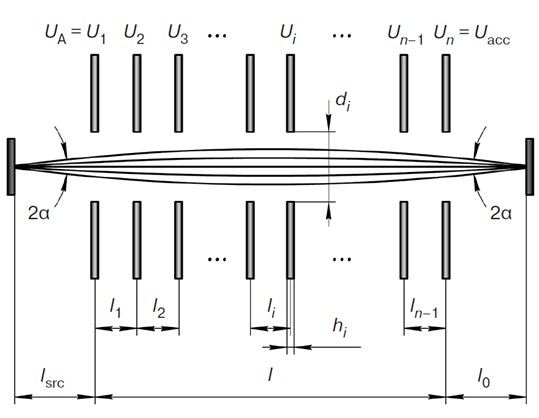
- The overall design and technological characteristics of microminiature electron-optical systems for achieving maximum performance indicators were systematically analyzed and optimized.
- Comprehensive mathematical modeling of electron dynamics in a complex five-electrode configuration that accurately reproduces the design of a compact electron-beam microcolumn was performed.
Objectives. The work set out to systematically analyze and optimize the overall design and technological characteristics of microminiature electron-optical systems for achieving maximum performance indicators. The study paid special attention to establishing relationships between the geometric parameters of the system and its functional characteristics.
Methods. The research is based on comprehensive mathematical modeling of electron dynamics in a complex five-electrode scheme that accurately reproduces the actual design of a compact electron-beam microcolumn. This approach was used to establish the quantitative dependencies of resolution and electron beam intensity critical system performance indicators on fundamental geometric parameters: interelectrode distances, diaphragm aperture configurations, and output angular size. The main efforts focused on determining the optimal parameter values while ensuring minimal focal spot size and simultaneously maximizing beam energy.
Results. The computer modeling revealed the determining influence of each component of the five-element electron-optical structure on the formation of qualitative electron flow characteristics. A pronounced minimum in electron beam diameter was established at a specific combination of geometric and electrical system parameters. The thus-obtained optimum was used to develop a new methodology for designing and calibrating compact electron-beam devices that ensures maximum resolution and high sensitivity with minimal power consumption. Detailed analysis demonstrated that the optimal electrode configuration reduces spherical aberration by 25% compared to traditional solutions.
Conclusions. The developed design approach for microcolumn electron-optical systems significantly enhances performance while expanding the functional capabilities of electron microscopes and related analytical instruments. The practical significance of the work is confirmed by the possibility of creating devices with record resolution indicators in compact sizes. An important achievement is the establishment of quantitative optimization criteria for enabling targeted improvement of electron-beam system characteristics.
MATHEMATICAL MODELING
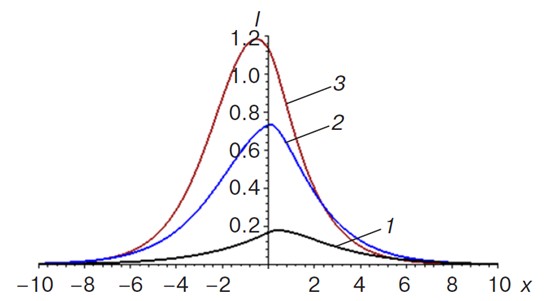
- The properties of surface transverse waves propagating along the interface between a nonlinear and a graded-index medium were modeled.
- A mathematical model was formulated, consisting of a boundary value conjugation problem for a nonlinear equation with variable coefficients.
- Exact analytical solutions to this boundary value problem were found for the cases of focusing and defocusing nonlinearities to describe the spatial distributions of the electric field strength in the direction transverse to the interface.
Objectives. An important role in modern physics, particularly in waveguide optics, is played by studies that involve the search for exact solutions to equations used in modeling to identify classes of exactly solvable models. This work set out to use analytical modeling methods to explore the properties of surface shear waves propagating without loss along the interface between a nonlinear and a graded-index nonmagnetic medium.
Methods. Methods of mathematical modeling, calculus, mathematical physics, differential equations, and the theory of special functions were used. Fundamental principles, methods, and physical models of nonlinear and waveguide optics were also applied.
Results. The properties of surface transverse waves propagating along the interface between a nonlinear and a graded-index medium are modeled. In order to model the nonlinearity of the medium to describe the nonlinear optical response of the medium to electric field perturbations, the linear dependence of permittivity on light intensity is chosen as a parameter. The graded-index medium is modeled using a spatial profile of permittivity as a function of distance from the interface for which an exact analytical solution to the stationary wave equation can be found. A mathematical formulation of the model is presented, consisting of a conjugation boundary value problem for a nonlinear equation with variable coefficients. Exact analytical solutions to this boundary value problem are found for the cases of focusing and defocusing nonlinearities to describe the spatial distributions of the electric field strength in the direction transverse to the interface. Analysis of the model revealed significant differences in the spatial distribution of the field intensity in surface waves propagating in the focusing and defocusing media. The effect of the values of model parameters used to characterize the optical properties of the contacting media on the spatial distribution of light intensity in surface waves was also studied in detail.
Conclusions. The obtained, which results supplement the existing theory of nonlinear and waveguide optics, can be applied in the design of new waveguide structures with user-defined properties. The obtained new solutions expand the class of exactly solvable models of planar waveguide structures with distributed inhomogeneous and nonlinear properties.
ECONOMICS OF KNOWLEDGE-INTENSIVE AND HIGH-TECH ENTERPRISES AND INDUSTRIES. MANAGEMENT IN ORGANIZATIONAL SYSTEMS
- The new approaches to strategic planning methodology in the electronics industry that take into account the current global multi-vector economic transformation and corresponding acceleration of technological changes was developed.
- It was concluded that economic and industrial sectors need radical restructuring and the electronics industry should play a leading role.
Objectives. The work sets out to develop new approaches to strategic planning methodology in the electronics industry that take into account the current global multi-vector economic transformation and corresponding acceleration of technological changes. The most general framework for the further development of the electronics industry is outlined along with a discussion of its likely impact on the socioeconomic structure of future society.
Methods. Along with classical methods for studying socioeconomic relationships pertaining to complex systems such as the electronics industry, systems analysis, foresight technologies, production process modeling, and strategic planning methods are applied. In order to evaluate the explanatory power of different development models, particular attention is given to the multiple comparison method.
Results. The study identifies a need for a radical restructuring of economic and industrial sectors in which the electronics industry is accorded a leading role as a result of its development transcending traditional economic rationalizations to acquire a civilizational character. The establishment of the electronics industry as the main driving force for the entire economy, along with a corresponding restructuring of personnel training, thus represents a key strategic element in Russia’s continuing development.
Conclusions. In the ongoing race for technological (and therefore economic, military, and political) sovereignty, the creation and continuous development of a strategic planning and management system for the electronics industry acquires a strategic character. The establishment of a genuinely independent national macroeconomic region can be achieved by ensuring self-sufficiency in both the production and consumption of electronic products.
PHILOSOPHICAL FOUNDATIONS OF TECHNOLOGY AND SOCIETY
- Considering the main features of humanity’s interaction with the environment, the factors and nature of changes in the anthropogenic burden are analyzed to reveal the stages according to which environmentalism is shaped as part of the global political agenda.
- Based on a comparison of the climatic picture of the past and modernity, priorities for steering the environmental agenda as a key component of the emerging world system are identified.
Objectives. Nowadays, the global environmental agenda has become a significant factor in world politics and international relations. Along with climate change, growing demographic and technological pressures on the environment, the degradation of ecosystems, and the depletion of nonrenewable natural resources represent a single set of environmental challenges for humanity as a whole, which will remain relevant throughout the 21st century. The objective of this article is to consider the technological and sociocultural aspects of modern global environmental challenges in terms of their interconnectedness.
Methods. The article is based on the systems history method and the cycles and waves approach to studying global dynamics.
Results. Considering the main features of humanity’s interaction with the environment, the factors and nature of changes in the anthropogenic burden are analyzed to reveal the stages according to which environmentalism is shaped as part of the global political agenda. Based on a comparison of the climatic picture of the past and modernity, priorities for steering the environmental agenda as a key component of the emerging world system are identified.
Conclusions. The overall anthropogenic impact on the environment is determined by a number of sociocultural, economic and technological factors. Although the degree of this impact has been increasing throughout history, climate change as such does not have a pronounced anthropogenic nature, being driven mainly by solar and geophysical cycles. Meanwhile, the very fact that climate change has become a key element of the global environmental agenda often leads to imposing regulatory requirements and technological standards that slow down the pace of industrialization and modernization in developing countries. In the context of the emerging world system architecture, it becomes possible to rethink the environmental agenda and repurpose it to take account of the priorities of climate forecasting and adaptation to ensure environmental safety while developing environmentally appropriate nature-similar technologies.
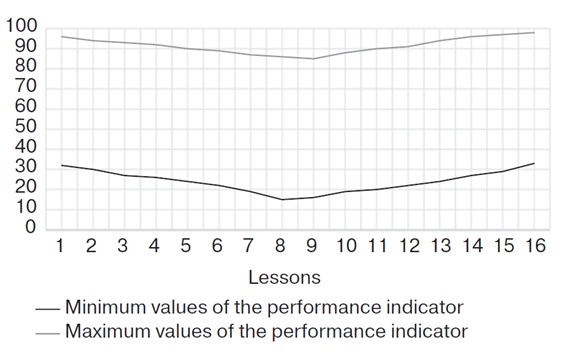
The didactic models for teaching French reading rules to first-year students from scratch, followed by a choice of the appropriate model to use in teaching, was developed.
Objectives. The work set out to develop didactic models for teaching French reading rules to first-year students from scratch, followed by a choice of the appropriate model to use in teaching.
Methods. The application of didactic models developed using tools such as regression analysis and mathematical theory of learning along with an experiment on the application of the obtained models in groups of French language learners “from scratch.”
Results. Three obtained models of studying 48 French reading rules over 4, 8, and 16 weeks with 12, 6, and 3 rules per lesson respectively, along with a review of the rules learned in the previous lesson, are presented for comparison and analysis. The influence of various factors such as students’ linguistic abilities, their levels of anxiety, previous language learning experience, etc., on the effectiveness of all three models were also taken into account. Based on the results of these analyses, the optimal learning model was chosen.
Conclusions. The average student learned reading rules more efficiently during an eight-week course when the rules were regularly reviewed at each lesson until the end of the semester. When studying reading rules for 16 weeks, students failed to review some material at the end of the semester, with fewer rules being reviewed in lesson. During a four-week study, students confused the rules and had difficulties to remember them due to cognitive overload. In the presence of adverse factors (weak ability and motivation, lack of independent work, etc.) training results were low regardless of the model chosen. On the contrary, under favorable conditions (good abilities, motivation, etc.) the learning model was turned out to be unimportant.

ISSN 2500-316X (Online)