INFORMATION SYSTEMS. COMPUTER SCIENCES. ISSUES OF INFORMATION SECURITY

A methodology for analyzing the functioning of socioeconomic systems was developed for increasing the efficiency of decisions made to manage these systems based on the clustering of temporal multidimensional data.
Objectives. The aim of information support for management decision-making is to find the most optimal option. Cluster analysis of multivariate data characterizing socioeconomic systems is widely used. In this work, the author aims to increase the efficiency of decisions made to manage these systems based on the clustering of temporal multidimensional data.
Methods. The methods of cluster analysis were used, as well as the provisions of the theory of systems and mathematical statistics.
Results. A methodology for analyzing the functioning of socioeconomic systems was developed. The analysis is implemented in three stages. Firstly, clustering over the values of feature variances was applied. Secondly, the distance of clustering objects from the center of their cluster and their dispersion was calculated at the points of time coordinates. Thirdly, the change in belonging to a certain cluster of objects that came into view earlier was monitored. Unstable systems were then identified.
Conclusions. Two cases were considered to justify the effectiveness of the methodology developed herein. First, using the example of the tax administration, the detection of deliberate distortion of information was considered. Secondly, identifying the abnormal functioning of the regions of the Russian Federation using the example of decision-making in the framework of socioeconomic development management was considered. The analysis demonstrated good results and we can thus recommend the proposed methodology for practical use in information systems for supporting management decisions.

An architecture for a distributed testing system for Internet of Things devices was developed to ensure secure transmission and the isolated execution of test scenarios on dedicated execution modules.
Objectives. The paper sets out to develop an architecture for a distributed testing system for Internet of Things (IoT) devices to ensure secure transmission and the isolated execution of test scenarios on dedicated execution modules. The study takes account of the rapid growth in the number of IoT devices operating in untrusted computing environments, in which the testing process can pose a risk of confidential data leakage or unauthorized interference with software components.
Methods. A comparative analysis of existing solutions such as NI TestStand, MagicDAQ, PHiLIP, and KEOLABS ContactLAB was conducted. Architectural components and test scenario life-cycle processes were examined and compared.
Results. The analysis identified the main stages of the test scenario life cycle, including preparation and storage of scripts, transmission and interpretation, interaction with the device under test, as well as registration and analysis of results. In addition, existing and proposed architectural solutions were compared according to the following key characteristics: application domain; type of architecture (distributed or centralized); test scenario execution environment; system scalability; level of execution isolation; availability of protection mechanisms; capability for remote management. The results of the study are presented in the form of a proposed architecture that includes a control module and autonomous execution modules with an isolated virtual MicroPython environment. To ensure security, test scenarios are transmitted over an encrypted communication channel using constrained application protocol and datagram transport layer security (protocol, while the execution of test code takes place in a restricted environment isolated from the main operating system.
Conclusions. The comparative analysis confirmed that the proposed solution eliminates the key limitations of existing solutions, namely the lack of encryption mechanisms and isolation of execution. The developed architecture enhances the security and reliability of the IoT device testing process, offering protection for intellectual property and test scenario logic in untrusted computing environments.

- A comparative evaluation method is introduced to assess the efficiency of heterogeneous computing architectures based on massively parallel hardware accelerators composed of independently programmable nodes.
- A computational acceleration ratio is defined which consolidates three key dimensions of accelerator improvement.
- The study proposes an optimization-based methodology for the systematic analysis and evaluation of the alternatives for hardware accelerator implementation.
Objectives. The growing demand for higher computational performance and energy efficiency has motivated the increasing adoption of specialized heterogeneous computing systems incorporating hardware accelerators with massive parallelism. This paper aims to develop a methodology for the analysis and evaluation of hardware accelerator implementation strategies for large-scale parallel stream data processing which systematically captures all major directions of performance improvement.
Methods. The study employs established techniques of digital system design and modeling.
Results. A comparative evaluation method is introduced to assess the efficiency of heterogeneous computing architectures based on massively parallel hardware accelerators composed of independently programmable nodes. A computational acceleration ratio is defined which consolidates three key dimensions of accelerator improvement: algorithmic support and microarchitecture; design automation tools; and fabrication technologies (lithography). Furthermore, the study proposes an optimization-based methodology for the systematic analysis and evaluation of the alternatives for hardware accelerator implementation.
Conclusions. The expressions derived herein for calculating the computational acceleration ratio and the aggregate throughput of hardware accelerators account for both multichannel and block-based massively parallel data stream processing. In contrast to conventional architectural exploration approaches, the evaluation method proposed herein enables hardware accelerator design alternatives to be assessed at the earliest stages of the design cycle. This incorporates variations in algorithmic versions and implementation strategies which influence hardware architecture optimization. The proposed methodology for analyzing and evaluating implementation options for hardware accelerators can be used to develop technical specifications for their manufacture, design them according to specified requirements, and justify configuration decisions. It can also support research and development assignments to achieve target characteristics for certain domain-specific tasks of massively parallel stream data processing and CAD capabilities.

- An architecture of a software package for preprocessing, analyzing, and visualizing curricula following the SOLID principles of object-oriented programming was developed.
- The package in C++ was implemented, in order to calculate curriculum characteristics and build a graph representation.
Objectives. The purpose of this study is to identify methods and approaches to developing a software package which can automate the processing, analysis, and visualization of curricula in educational programs.
Methods. We provide an overview of relevant scholarly literature and research results. The software package applies regular expressions for data processing, comparative analysis, and descriptive statistics to identify differences. It also uses a graph-based model for visualization.
Results. We designed the architecture of a software package for preprocessing, analyzing, and visualizing curricula following the SOLID principles of object-oriented programming. We implemented the package in C++, in order to calculate curriculum characteristics and build a graph representation. This formed the basis of our proposed visualization method. We demonstrate the functionality of the package through a comparative analysis of curricula, identification of distinctive features, and detection of design shortcomings.
Conclusions. Our software package helps identify specific features, reveal possible weaknesses, and support the comparative analysis of different curricula. Using it improves the quality of educational process management, addresses gaps in educational data analysis, and contributes to the creation of a university digital ecosystem. The results of our study are useful for faculty members designing and developing curricula, as well as administrative and managerial staff (including those in academic affairs) and other higher education stakeholders.
MODERN RADIO ENGINEERING AND TELECOMMUNICATION SYSTEMS

The mechanisms of the nonlinear formation of a wideband pulse spectrum under overload conditions in ultra-wideband amplifier circuits were investigated in resolving problems related to radiovision gesture recognition.
Objectives. The paper aims to investigate the mechanisms of the nonlinear formation of a wideband pulse spectrum under overload conditions in ultra-wideband (UWB) amplifier circuits in resolving problems related to radiovision gesture recognition. The relevance of the study stems from the need to enhance the accuracy and noise immunity of modern radiovision UWB systems for gestural control interfaces.
Methods. The study used statistical radiophysics, time-frequency methods of wavelet transformation of radio images, the theory of S-parametric vector analysis of circuits, and software-numerical modeling.
Results. The method for generating UWB signals in the microwave range based on controlled nonlinear signal distortion is presented. When the amplifier is switched to the saturation mode, a signal with sharp fronts is formed with a wide energy spectrum. A laboratory setup of a cyber-physical system for gesture recognition using radio sensing was developed, and its characteristics were investigated. The properties of the pulses generated in radiovision control systems were also studied. The effectiveness of the proposed approach for the tasks of radiovision gesture recognition was experimentally demonstrated.
Conclusions. A method of nonlinear saturation-synthesis of the spectrum of radiovision signals based on transient distortion phenomena in UWB amplifiers is proposed. It was shown that, when the initial frequency band is expanded up to 900 MHz, the interference mode can provide phase image repeatability of at least 0.94. It was also established that in the input overloaded mode of the SBB5089Z type amplifier with low-mode harmonic excitation at a transition frequency of 47 MHz in a cascade amplification scheme, a signal with a modified spectrum can be obtained at the output of the radio antenna. In this case, the controlled formation of the antenna excitation spectrum for each amplifier module is determined by means of the unique impulse characteristic of the integrated UWB-amplifier. This allows for the successful application such amplifiers in resolving problems related to radiovision gesture recognition. The methodology proposed allows the use of standard UWB amplifiers to create compact sources of UWB signals without the complication of circuitry.
MICRO- AND NANOELECTRONICS. CONDENSED MATTER PHYSICS

- Various methods were analyzed to minimize image defects in a hybrid photodetector with a sensitivity range of 0.95–1.65 μm, based on an InP/InGaAs photocathode.
- A technology was developed to improve the surface quality of the photocathode before lift-off photolithography.
Objectives. The primary aim of this study is to minimize image defects in a hybrid photodetector with a sensitivity range of 0.95–1.65 μm, based on an InP/InGaAs photocathode. In order to achieve this, the surface quality of the photocathode must be improved prior to lift-off photolithography. In addition, the photolithographic process must be made highly reproducible.
Methods. In order to achieve this goal, a series of experiments on surface cleaning and improvement of the lift-off photolithography process were conducted. The following surface preparation methods were tested: chemical etching of the InGaAs surface; coating the photocathode surface with a protective photoresist layer before cutting the plate; using various photoresist removal methods (in dimethylformamide and plasma); and mechanical surface cleaning. In order to improve photolithography, experiments were conducted on drying times and photoresist methods, exposure and development modes were varied, and photoresist was replaced.
Results. Samples manufactured using the improved technology demonstrate a more than ninefold reduction in the average percentage of defects on the photocathode surface from 0.317% to 0.035%. Thanks to the improved quality of the photocathode surface, the image in the finished device is more uniform and the number of image defects significantly decreased. The process is highly reproducible.
Conclusions. Improvements in surface preparation technology, coupled with a reduction in the thickness of the photoresist used in lift-off photolithography lead to greater uniformity of images in hybrid devices and fewer defects. The proposed approach can be used for the mass production of high-sensitivity near-infrared hybrid photodetectors, making them competitive with those produced elsewhere.

- Physically unclonable functions were considered as components of the hardware security infrastructure.
- A formal description of physically unclonable functions and designs based on memory modules and timing analysis were presented.
Objectives. Modules that implement physically unclonable functions (PUFs) within a digital chip facilitate the direct use of challenge–response pairs by device applications that can query and read the PUF without external tools or exposing data outside the chip. A PUF can be implemented using technological processes and components already applied in device fabrication. The first of two reviews on PUFs as elements of hardware security infrastructure, the present paper focuses on the formal description of PUFs and designs based on memory modules and timing analysis.
Methods. The following quantitative indicators were applied to formally describe PUFs: computability, uniqueness, feasibility, cloning resistance, and protection against unauthorized access.
Results. PUFs are considered as physical devices with unique signatures. A classification into three PUF groups is proposed: delay-based, memory-based, and analog. Typical examples of the first two groups are outlined. While delay-based solutions provide a large challenge–response space, they require symmetry and/or calibration. In contrast, memory-based PUFs are easier to implement in integrated circuits. With suitable post-processing, they can achieve high reproducibility, making them practical for many applications. Approaches to mitigating voltage and temperature variations are described along with examples of strong memory-oriented PUFs and circuit techniques that enhance resistance to attacks.
Conclusions. PUF-based security technologies demonstrate significant potential, particularly for the Internet of Things. When combined with post-processing and compensation methods, PUFs constitute a mature and effective tool for hardware security.
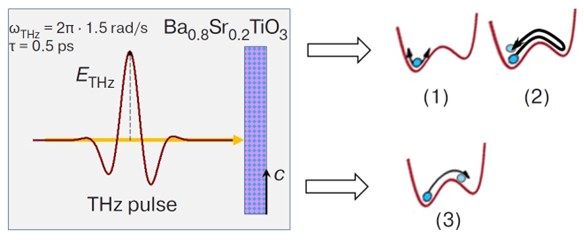
- The conditions for modulating ferroelectric polarization using a short THz pulse were studied.
- The time dependencies were presented for the polarization and the effective amplitude of infrared-active mode oscillations with varying THz field parameters.
Objectives. The search for a fundamentally new, fast, and least dissipative method for controlling the ferroic order parameter is a pressing and ambitious task of basic and applied research on the development of low-dissipation and high-speed functional elements of information systems operating at terahertz (THz) frequencies for 6G network technologies. The aim of the work is to study the conditions for modulating ferroelectric polarization using a short THz pulse. This will also include the influence of additional factors on the efficiency of the THz-induced dynamics of the ferroic order parameter, such as stationary heating and the application of an additional electric field to the ferroelectric.
Methods. The numerical simulation of resonant excitation of the lattice subsystem by THz radiation was performed for a Ba0.8Sr0.2TiO3 ferroelectric film using the Landau–Khalatnikov equation system, and the equation of phonon mode oscillations with the phonon–phonon interaction as a driving force. The novelty of the proposed approach lies in the interaction of the THz pulse with a previously coherently excited phonon mode with a significant amplitude.
Results. The time dependencies were presented for the polarization and the effective amplitude of infrared-active mode oscillations with varying THz field parameters. The results also included constants of expansion of the thermodynamic potential of the nonequilibrium state in powers of order parameter in various exposure modes, including temperature changes and the application of an additional external electric field.
Conclusions. The approach proposed herein describes polarization switching under the action of a THz pulse with preliminary excitation of a coherent phonon by a femtosecond optical pulse. The most important parameter when determining the threshold effect of a THz pulse on phonon excitation is pulse energy (amplitude). In the region of small amplitudes, an increase in temperature does not exacerbate switching conditions.
MATHEMATICAL MODELING

The influence of inhomogeneities of laser flux intensity and piston (mylar film) thickness was investigated in a laser shock tube by comparing the conditions for the formation and dynamics of shock wave propagation in a laser shock tube in the case of an open and closed plasma corona.
Objectives. The study investigates the influence of inhomogeneities of laser flux intensity and piston (mylar film) thickness in a laser shock tube by comparing the conditions for the formation and dynamics of shock wave propagation in a laser shock tube in the case of an open and closed plasma corona.
Methods. Along with mathematical modeling methods, analysis of the results of computational experiments was carried out using the two-dimensional Lagrangian program Atlant_C in cylindrical coordinates were used.
Results. The results of four series of calculations of the dynamics of hypersonic shock waves in a laser shock tube are presented: (1) formation and propagation of a shock wave in a profiled target; (2) formation and propagation of a shock wave with strong inhomogeneity of the incident laser flux; (3) comparison of the dynamics of shock waves for different values of the absorbed laser pulse energy and target (piston) thicknesses; (4) comparison of shock wave dynamics in the cases of open and closed plasma coronas.
Conclusions. Based on the results of the computational experiments, the following conclusions can be drawn: (1) as a strong shock wave propagates in the profiled piston, the pressure and density equalize in the transverse direction. If the duration of the laser pulse is noticeably longer than the transit time of the transverse shock waves in the target (piston), the shock wave front flattens out in the gas inside the LUT cell; (2) in cases when the incident laser pulse contains significant emission intensities or speckles (more than 10% of the pulse energy), jets are formed in the accelerated piston, which can overtake the shock wave front in the gas; (3) during laser heating of the target in the closed corona mode, the propagation velocity of the shock wave front increases by ~40%; (4) when the piston is destroyed due to strong nonuniformity of irradiation or development of hydrodynamic instability and fragmentation of the polymer CH film, a dense turbulent layer can form, which will also create a shock wave in the gas. This case requires separate consideration.

- The mathematical tools to assess the performance and probabilistic-temporal characteristics of packet transmission processes in industrial networks employing random multiple access were developed.
- A theorem was formulated and proved which defines the Laplace–Stieltjes transform for the packet transmission time distribution function.
- A software package was developed and implemented, in order to automate the study and evaluate various network operating modes during scaling and under increased nodal load.
Objectives. The aim of the study was to develop mathematical tools to assess the performance and probabilistic-temporal characteristics of packet transmission processes in industrial networks employing random multiple access. Our study specifically examined strict packet delivery time constraints and the impact of collisions.
Methods. The research applies methods from the theory of random processes. We used the Laplace–Stieltjes transform to derive key relationships analytically and prove the main theorem.
Results. We formulated and proved a theorem which defines the Laplace–Stieltjes transform for the packet transmission time distribution function. The result incorporates packet retransmissions caused by conflicts in the multiple access environment. We analyzed information transmission processes in industrial networks with random multiple access, considering variations in the number of workstations and packet flow intensities at network nodes. Our evaluation included throughput, node and transmission medium utilization, and packet transmission times under collision conditions. The results reveal significant differences in the temporal characteristics of packet transmission between central and edge nodes. We developed and implemented a software package, in order to automate the study and evaluate various network operating modes during scaling and under increased nodal load.
Conclusions. The study of industrial networks with random multiple access established that while network throughput increases with the number of nodes during scaling, it degrades under significantly high node and transmission medium utilization. The utilization of edge nodes and their packet delivery times increase markedly faster than those of central nodes. This is due to a higher collision rate. As the network size increases, the performance and temporal characteristics exhibit only marginal dependence on the node distribution type: random or deterministic equidistant. In order to ensure balanced operation in an industrial network with random multiple access, we propose reducing the load on edge nodes by 10–15%. This strategy can maintain approximately uniform utilization of both the transmission medium and the nodes as their number increases.
PHILOSOPHICAL FOUNDATIONS OF TECHNOLOGY AND SOCIETY
- A comprehensive approach to grounding decisions aimed at advancing the scientific and educational infrastructure of an engineering university was developed.
- The importance of collaboration with industry partners in driving innovation, helping to ensure that educational programs, research, and development align with market needs, was demonstrated.
Objectives. The work sets out to develop a comprehensive approach to grounding decisions aimed at advancing the scientific and educational infrastructure of an engineering university. This includes selecting modernization policies for the scientific and educational infrastructure, substantiating the format of scientific and educational infrastructure objects in light of the diversity of current tasks, involving industry partners in implementing infrastructure policies, as well as addressing resource support issues using mathematical formalization and analytical evaluation tools.
Methods. Methods of systems and strategic analysis, comparison and formalization, modeling and statistical indicators, as well as change management, risk assessment, and strategy actualization approaches, were used.
Results. Ensuring the contribution of modern engineering universities to technological leadership is an ambitious task that requires a focused approach to the development of scientific and educational infrastructure. One effective solution consists in the creation of specialized laboratories, or mega-laboratories, which are considered as an optimal format for the scientific and educational infrastructure. Such laboratories combine educational, research, and communication zones, along with their respective advantages and typologies. The importance of collaboration with industry partners in driving innovation, helping to ensure that educational programs, research, and development align with market needs, is demonstrated. A mathematical model is developed for evaluating projects associated with the establishment of a mega-laboratory based on a comprehensive system of indicators. This model was used to formalize the procedure for selecting and financing of newly created scientific and educational infrastructure.
Conclusions. Infrastructure constraints defined at the state level in the context of technological development and the need to ensure technological independence are becoming a key challenge for engineering universities. This necessitates the development of tools for seeking, justifying, and making managerial decisions. The described comprehensive approach takes into account current requirements for scientific and educational infrastructure facilities, including a high degree of integration between education and science, and the involvement of industry partners in the development process in order to bridge the gap between education, science, and the demands of the real economy. The formulated recommendations and proposed solutions effectively address the issues faced by modern engineering universities within development programs.

ISSN 2500-316X (Online)