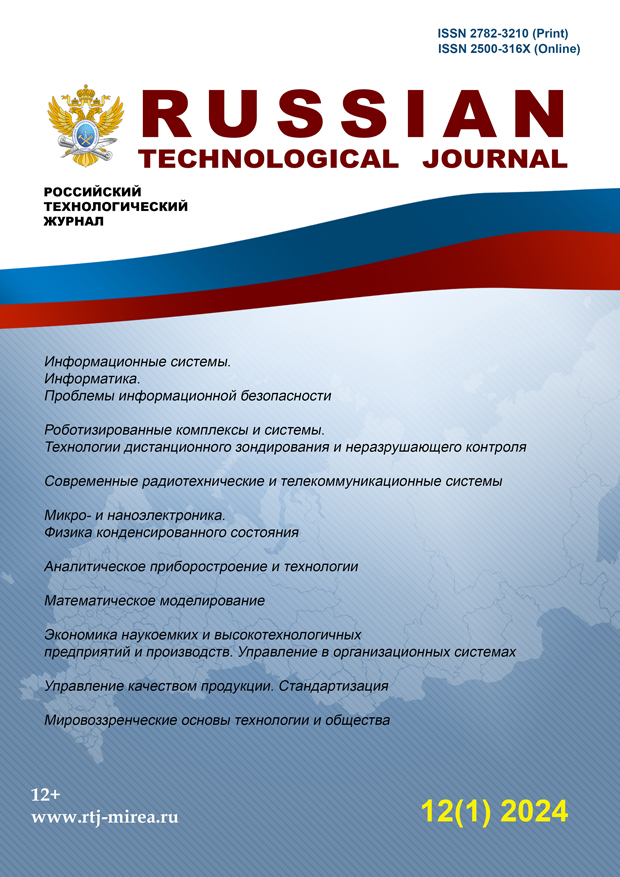
The periodic science and research reviewed edition Russian Technological Journal highlights the results of fundamental and applied interdisciplinary research on the complex development of radio engineering, telecommunications and information systems, electronics and computer science, as well as technological and organizational and economic developments aimed at the development and improvement of modern technological base.
Russian Technological Journal publishes original experimental and theoretical works in the form of unabridged articles, brief reports, authors' reviews and forward-looking analytical articles on topical issues of high technologies in the areas listed below.
- Information systems. Computer sciences. Issues of information security
- Multiple robots (robotic centers) and systems. Remote sensing and non-destructive testing
- Modern radio engineering and telecommunication systems
- Micro- and nanoelectronics. Condensed matter physics
- Analytical instrument engineering and technology
- Mathematical modeling
- Economics of knowledge-intensive and high-tech enterprises and industries. Management in organizational systems
- Product quality management. Standardization
- Philosophical Foundations of Technology and Society
The periodical printed edition Russian Technological Journal is the successor of the online electronic edition Rossiiskii Tekhnologicheskii Zhurnal (ISSN 2500-316Х) issued since December, 2015. Since 2013 to December, 2015, the title of the journal was Herald of MSTU MIREA (ISSN 2313-5026). All archives of Herald of MSTU MIREA are here.
The publisher of the journal is MIREA - Russian Technological University.
Publication frequency: bimonthly.
Publication in the Russian Technological Journal is free of charge.
The journal does not have any Article processing charges.
The journal does not have any Article submission charges.
Russian Technological Journal is an open access journal. All articles are freely available to readers immediately after online publication.
In the print form, the journal is distributed on the territory of the Russian Federation and CIS by subscription. The subscription index of the Pressa Rossii United Catalog is 79641.
The registration number ПИ № ФС77-81733 was issued in August 19, 2021 by the Federal Service for Supervision of Communications, Information Technology, and Mass Media of Russia.
Current issue
INFORMATION SYSTEMS. COMPUTER SCIENCES. ISSUES OF INFORMATION SECURITY
Objectives. The work set out to develop and substantiate a methodology for synthesizing high-performance and simultaneously verified implementations of elliptic curve cryptosystems.
The challenge of ensuring mathematical correctness and engineering security of the code was overcome by integrating machine-checkable proofs with automated inspection.
Methods. In order to carry out formal verification within the Coq interactive environment6, the study employs ring7 and nsatz8 tactics to automate algebraic proofs together with custom fold-based synthesis methods. For low-level security analysis, static range analysis and deductive verification are carried out within Frama-C9. The efficiency of the resulting solutions is evaluated through a comparative analysis of arithmetic complexity and execution time.
Results. The proposed approach is implemented by generating executable C code alongside a formal proof of its conformance to a simple mathematical specification to ensure the absence of algorithmic errors. Despite the rigor of the formal methods, the achieved performance approaches that of the best hand-optimized implementations. A key achievement consists in the development of a two-layer architecture for verified finite field arithmetic, which permits the extensive reuse of proofs across different curves and parameters. As part of the research, an explicit multiplication formula for the Curve2551910 curve in a 10-limb representation with weights 2⌈25.5i⌉ was synthesized and formally verified for the first time. This formula is identical to the classic high-performance implementation by Bernstein and Schwabe.
Conclusions. An end-to-end Coq → Frama-C pipeline was successfully built and tested, providing an end-to-end correctness guarantee: from the mathematical specification of elliptic curves to optimized C code verified for overflows, array index out-of-bounds error, and timing variability. The feasibility of the proposed approach is confirmed by the final performance of the synthesized code, which falls within 7 % of the best manually optimized implementations on the target architecture.
Objectives. The integration of machine learning (ML) into environmental monitoring contexts introduces a new spectrum of cyber threats. The general-purpose nature of current AI security frameworks and guidance (NIST, OWASP) makes them insufficiently tailored to the specific characteristics of environmental monitoring, including time-series data and high inherent sensor noise.
The present work therefore set out to develop a specialized classification of attacks on ML models used for automated industrial emissions monitoring systems and provide quantitative risk estimates.
Methods. An analytical review of over 25 scientific publications on adversarial machine learning and industrial Internet of Things (IoT) security was carried out. Sources were selected from IEEE Xplore, ACM Digital Library, Scopus, and arXiv prioritizing publications from 2019–2025 using the keywords “adversarial ML”, “data poisoning”, “evasion attacks”, “IoT security”, and “environmental monitoring”. Structural-functional analysis methods were applied to the ML system lifecycle. Available experimental data on neural network and ensemble algorithm vulnerabilities were synthesized to produce quantitative estimates of attack success rates and model degradation levels.
Results. A three-tier threat classification is proposed (data poisoning, evasion attacks, and model inversion), supplemented by a vulnerability matrix along the axes of data–model–platform. It is shown that the substitution of less than 5 % of training data results in a covert accuracy drop of 85 percentage points in deep neural networks (DNNs), while the most powerful evasion attacks achieve a success rate of 97–99% against single DNNs. A critical threat posed by composite attacks that combine IoT data drift with architectural weaknesses of algorithms to manipulate forecasting outputs is identified.
Conclusions. The secure deployment of predictive analytics requires a mandatory transition to proactive security architecture. To neutralize threats, the use of robust ensemble models, regular adversarial training, and strict validation of incoming data streams becomes necessary. Priority directions for future research involve the development of benchmark environmental datasets and AI cyber-resilience metrics as the central elements.
Objectives. The study set out to experimentally verify a proposed approach to adaptive cyber threat analysis for critical information infrastructure facilities using a digital twin of an industrial control system (ICS) for a power facility.
Methods. The system-engineering approach involved modeling representative cyber-attack scenarios on a seminatural cyber-physical testbed and generating synthetic multivariate time series telemetry within a digital twin. The threat detection model was then iteratively retrained based on the Random Forest3 ensemble algorithm. Strategies involving direct retraining on testbed data were compared with those relying solely on synthetic data generated by the digital twin. The evaluation criteria encompassed both the effectiveness of threat detection and the level of operational environment security. The authors’ proprietary metric, which considers the trade-off between threat detection recall and the risk of interfering with the real equipment operations, was used for quantitative assessment.
Results. The feasibility of the proposed approach was experimentally confirmed. The use of a digital twin provides a level of threat detection quality comparable to direct retraining on physical equipment while ensuring a substantially higher level of operational security. Based on the analysis of simulated attacks within the digital twin, two defensive measures were formulated and verified at the application logic level of the ICS: (1) a correlation rule for the SCADA4 system to validate the logical consistency of telemetry and (2) an adaptive multi-threshold control mechanism that accounts for the current operational mode of the power facility. Implementing these measures improved detection precision while maintaining recall to further enhance the system’s overall security. A series of a hundred independent experiments confirmed the statistical significance of the obtained results. The protective measures developed demonstrated resilience to various operating modes of the considered energy facility.
Conclusions. The proposed approach is suitable for carrying out adaptive cyber threat analysis without direct interaction with physical equipment, thereby complying with functional safety requirements and regulatory constraints applicable to critical information infrastructure facilities in the Russian Federation.
MICRO- AND NANOELECTRONICS. CONDENSED MATTER PHYSICS
Objectives. At high temperatures and high pressures, fullerene undergoes a series of phase transformations to form phases and structures offering remarkable mechanical and other physical properties. While it is known that the transformation of fullerene C60 into various polymerized phases is significantly affected by doping with atoms and molecules, studies of the transformations of fullerenes into disoriented graphite are almost absent. This article provides a brief review of the studies of transformations of fullerenes into disoriented graphite carried out by a team of researchers from RTU MIREA, the Kurchatov Institute, and the Institute of High-Pressure Physics of the Russian Academy of Sciences, in which the present author participated.
Methods. The study of the transformation of crystalline and amorphous fullerenes C60 and C70 was carried out at a pressure of 8 GPa in the temperature range of 500–1100 °C. Samples containing powders of fullerenes and doping elements were sintered in a high-pressure chamber; all measurements of the structure and properties were made at room temperature. Neutron and X-ray diffraction, Ramаn spectroscopy, transmission electron microscopy, and hardness and microhardness measurements were used.
Results. The effect of doping elements on the phase transformations of fullerenes into disoriented graphite at high pressure is shown to be determined by two factors: chemical interaction (formation of carbides) and size effect (difference in atomic radii between the doping element and carbon). It is demonstrated that the addition of carbide-forming metals with a strong size effect (Fe, Al, V, Cr) significantly increases the stability of crystalline fullerenes (increase the transition temperature by hundreds of degrees). Non-carbide-forming metals (Ni, Ag) do not have such an effect. The carbide-forming nonmetals B and Si, whose atomic radii are close to that of carbon, also do not significantly affect this transformation. Amorphization of fullerene accelerates the transformation process.
Conclusions. It is shown that the effect of doping elements on the transformation of fullerenes into disoriented graphite is determined both by their chemical interaction with carbon (formation of carbides) and by the difference in atomic radii of the doping element and carbon (the size factor). When these two factors coincide, the doping elements have a significant impact on the stability of fullerene and increase the temperature at which it transforms into disordered graphite by hundreds of degrees.
ANALYTICAL INSTRUMENT ENGINEERING AND TECHNOLOGY
Objectives. The work set out to develop a technological process for low-defect laser cutting of fragile materials, including glass, semiconductor materials, and various optical materials.
Methods. The advent of new industrial lasers based on short- and ultra-short pulse radiation has made it possible to create new technologies for laser immersion processing of materials (LIPM). The LIPM technology applies short- and ultra-short laser radiation to a material to form a small-sized region in the contact zone of the material with the cooling immersion liquid, which is filled with a supercritical fluid resulting from the absorption of laser radiation energy. This region, which has a relatively high specific energy, serves as a thermal accumulator (TA) in the LIPM technology. At the same time, the temperature effect on the processed material continues after the completion of the laser pulse until the self-destruction of the TA along with the transformation of the supercritical fluid into an immersion liquid without the formation of a gas phase.
Results. The processes of interaction between pulsed radiation, the processed material, and the immersion liquid in the contact zone with the formation of a supercritical fluid are described along with a determination of the composition and properties of the working body in the laser impact zone. The existence of TA is confirmed to intensify the material cutting process while simultaneously reducing the thermal impact zone. The intensification of the material cutting process in the TA zone is determined by both the increased duration of the thermal impact of the TA on the processed material and the presence of highly active atomic and molecular compounds in the supercritical fluid.
Conclusions. As a result of the conducted research, a new LIPM technology was developed that allows for high-efficiency laser drilling of microholes having a diameter of 30 μm or less, as well as the formation of holes of arbitrary shape and cuts along curved contours in both fragile optically transparent and optically opaque materials with high quality.
Objectives. Using the developed magnetic force meter using different samples of dispersed material as a ferrosonde, the work set out to determine possible changes in the location of the measuring zone in a magnetometer. Dispersed (in particular, powdered) materials having magnetically active properties are used in solving a wide variety of applied and scientific problems. However, the task of fine-tuning the magnetometer device (usually of the ponderomotive type) remains relevant. In particular, the identification of the executive zone intended for the location of the studied sample necessarily involves the study of their magnetic properties.
Methods. For direct measurements of the magnetic force, the engineered method was used by forcibly moving (between the poles-hemispheres of the magnetometer) a spherical ferrosonde in the form of a powder medium.
Results. A series of experiments were conducted using the designed magnetic force meter (at different values of the magnetometer’ magnetizing force) using four types of powders (based on iron and nickel) as ferrosondes. The magnetometer comprises a system having poles of diameter 184 mm located at a distance of 28 mm from each other. The establishment of coordinate characteristics (extreme in appearance) of this force made it possible to identify the executive zone of the magnetometer in its “chink” region between the fields. A series of similar experiments were carried out using a defectography powder and a powder of ferroparticles extracted from tea. The analysis of the obtained experimental data is performed.
Conclusions. A special meter was designed for carrying out direct measurements of the magnetic force in the inhomogeneous field of a magnetometer device having hemispherical poles. The extreme type of the coordinate characteristics of the magnetic force was confirmed using model powder media (based on iron and nickel). This solves the urgent problem of identifying the executive zone intended for dislocation of a dispersed sample when studying its magnetic properties. A series of similar experiments using samples of magnetically active powder for flaw detection and powder with
ferro-impurities, which were extracted earlier from tea, were carried out to verify the position of the executive zone.
MATHEMATICAL MODELING
Objectives. The work set out to justify the expediency and provide a conceptualization of an agent-oriented approach to building distributed intelligent systems that operate under conditions of incomplete initial data, high stochasticity, and non-stationarity of the external environment. Formal models of agents and methods for their cooperation were developed as part of a decentralized architecture that ensures adaptability, scalability, and fault tolerance. A distributed knowledge storage and processing subsystem was designed and implemented.
Methods. In order to solve the problems, agent modeling methods were integrated with automata theory, Markov decision processes, fuzzy logic, artificial neural networks, multi-agent reinforcement learning algorithms, along with expert evaluation procedures to ensure the verification and practical adaptation of the developed theoretical provisions.
Results. The developed multi-agent intelligent system architecture based on the cooperation of autonomous software agents provides decentralized control, weak coupling of components, and scalability of the computing infrastructure. The proposed formal mathematical model of an intelligent agent integrates symbolic knowledge representation methods and neural network algorithms. A distributed knowledge base management subsystem was developed to provide dynamic reconfiguration of information flows, adaptive optimization of data storage and processing schemes, intelligent caching, semantic consistency, and support for non-monotonic distributed knowledge-based inference. A dynamic load balancing subsystem was implemented based on a coalition of system software agents.
Conclusions. The described agent-oriented paradigm is an effective methodological basis for building distributed intelligent systems aimed at solving problems in poorly formalized problem domains characterized by incomplete data, uncertainty, and non-stationary external environments. Decentralized management and distributed knowledge base organization allow overcoming the fundamental limitations of monolithic intelligent systems which use the complete and consistent knowledge base and the monotonous logical inference, as well as ensuring the scalability and high fault tolerance of the developed system. The mechanisms of dynamic optimization of a distributed knowledge base and adaptive balancing of computational load implemented in a multi-agent intelligent system can be used not only to solve intelligent problems, but also to effectively manage their own computational and information resources.
Objectives. This paper considers the role of mathematical modeling in the development of complex assemblies and components in mechanical engineering, especially in terms of predicting the operational behavior of assemblies, as well as that of housing components during machining at the design stage.
Particular attention is paid to the difficulties arising from the multifactorial nature, uncertainty, and nonlinearity of the objects under study, as well as the high reliability requirements of the products being manufactured.
The development of a variational approach for assessing the rigidity of assemblies and the stability of components during machining is presented.
Methods. Among the mathematical modeling approaches used at various stages of development, particular attention is paid to finite element analysis, which allows for a detailed study of the mechanical stresses experienced by structural elements during the manufacture and machining of complex components. Analytical techniques are employed to analyze the specific features of forming mathematical models of complex assemblies. The parametric identification method is used to determine the mechanical characteristics of complex components.
Results. The need to integrate computer technologies and experimental research to improve the efficiency of mechanical engineering design and manufacturing processes is substantiated. The key stages and approaches to creating mathematical models of complex objects are outlined on examples of the successful implementation of numerical analysis and computational mechanics methods in component manufacturing. Experiments revealed that the current theories for modeling complex objects demonstrate a high level of model adequacy.
Conclusions. The parametric identification method is shown to be suitable for analyzing critical loads on load-bearing components of complex assemblies and in the design of highly loaded components that require high rigidity and stability during machining.
Objectives. The work set out to improve the technological process of hot plastic shaping of products having blind, narrow and deep cavities, such as piercing mill mandrels, in order to increase the durability of the tool and expanding the technological capabilities of the process.
Methods. Digital modeling based on the finite element method using the QForm2 program was used to investigate the technological process of hot stamping the mandrel of a piercing mill from a tube blank.
Results. The developed technology supports the use of a tubular billet with an outer diameter of 0.84–0.98 of the maximum diameter of the piercing mandrel and an inner diameter of 0.80–1.0 of the largest diameter of the cavity. The technological process includes cutting and heating operations of the initial tubular billet, as well as hot stamping of the outer working profile and the inner blind cavity of the forging, which is performed on a crank press by application of force. Digital simulation was used to study the proposed technological process in order to select optimal process parameters, reduce operating stresses, temperature and wear of the tool and increase its durability. The study investigated the nature of the shape change of the pipe billet, the macrostructure of the forging metal, the stress-strain state of the forging metal, and the technological force on the forging transitions. Digital modeling of the process confirmed a decrease in tool wear indicators from pressure and friction forces when using a tubular billet when obtaining hot stamping products with deep cavities by 3.1–4.5 times.
Conclusions. Tubular billets can be used in hot forging of forgings with blind and narrow cavities to reduce number of transitions along with the temperature and wear of tool. The obtained results indicate the prospects of using the proposed process of hot die forging for manufacturing products having deep cavities from tubular blanks.
ECONOMICS OF KNOWLEDGE-INTENSIVE AND HIGH-TECH ENTERPRISES AND INDUSTRIES. MANAGEMENT IN ORGANIZATIONAL SYSTEMS
Objectives. The problem of correctly defining the target state of business processes, which determines whether the results align with a company’s strategic priorities, is key in the digital and business transformation of organizations. Current goal-setting practices, which rely primarily on expert assessments and stakeholder requirements, are characterized by methodological limitations, which include excessive subjectivity and insufficient validation of hypotheses. This work sets out to substantiate and develop an integrated approach to defining the target state of business processes that combines strategic goal-setting tools and verification methods to improve the validity of the proposed changes.
Methods. The study is based on a critical analysis of existing approaches to goal setting in transformation projects. To overcome the identified limitations, a synthesis of two methodological tools is proposed: the use of the objectives and key results (OKR) system to decompose long-term strategic priorities into measurable indicators of the target process state combined with A/B testing tools to experimentally test hypotheses about which changes in key results lead to the achievement of a strategic goal.
Results. The integration of OKRs and A/B testing is shown to create a closed-loop change management system. OKRs provide strategic navigation to ensure that the target state is consistent with the company’s mission. A/B testing, in turn, adds an empirical basis for goal setting, allowing for the confirmation or refutation of hypotheses about the impact of process changes on desired business outcomes based on data rather than intuition. By improving the adaptability of the process to environmental changes, this approach reduces the risk of implementing ineffective project solutions.
Conclusions. The proposed approach bridges the gap between abstract strategic goals and operational changes to improve methodological rigor in goal-setting through a synthesis of planning and experimental testing. Research prospects lie in scaling the approach to complex process architectures and interpreting A/B test results to adjust OKRs.
PHILOSOPHICAL FOUNDATIONS OF TECHNOLOGY AND SOCIETY
Objectives. The paper provides a fundamental explication of the ontological and epistemological status of the human subject (integral personality) within the context of the modern information and technology society. Assuming a shift from the industrial paradigm to the infosphere, the authors analyze the crisis of human subjectivity resulting from the conflict between the existential need for meaning (Being) and the total dominance of data (Information).
Methods. The methodological foundation of the work is phenomenological hermeneutics, supplemented by the principles of V. A. Lektorsky’s nonclassical epistemology and constructive realism. The paper systematically examines the phenomenon of the digital panopticon and its impact on the structures of consciousness through the descriptions of the categories of transparency and disappearance of the Other (B.-C. Han).
Particular attention is paid to the ethical challenges of surveillance capitalism, which transforms human experience into behavioral raw material. Drawing on a corpus of studied texts (including works by N. V. Motroshilova et al.), the authors substantiate a thesis concerning the risks of high-tech barbarism a state of post-industrial society in which technical rationality displaces the civilizational value core. As a normative reference point, the reactualization of Aristotelian phronesis (practical wisdom) and Bakhtin’s dialogicity (polyphony) is proposed as tools for preserving the autonomy
of the informational Dasein.
Results. Regarding the challenges of the digital age, the authors point out that behind the façade of the infosphere and algorithms lie the same eternal questions that have troubled philosophers from Plato to Heidegger concerning the nature of Techne—art or craft as a means of revealing the concealed. This requires us to reconsider the natures of the Subject and Time.
Conclusions. The work concludes that digital rights require ontological justification and the formation of a new epistemology of resistance to counter algorithmic determinism.

ISSN 2500-316X (Online)